Tb 500 Bpc 157 Can you take BPC-157 and TB 500 daily?
Can You Take BPC-157 and TB 500 Daily? A Cautious Consumer-Review Guide for 18–24 Men
“Can you take BPC-157 and TB 500 daily?” is a search query I see because a lot of young, training-focused men are trying to solve a frustrating problem: small injuries that refuse to fully settle. Maybe it’s tendon irritation, nagging joint discomfort, or the “I’m almost fine but not quite” phase after a hard training cycle. When people look for BPC-157 and TB 500 daily stacks, they’re usually aiming for one thing—consistency. Daily use sounds simple: take it regularly, track changes, and get back to training.
But “daily” is where the nuance matters. In real life, the question isn’t just whether the compounds can be taken each day—it’s whether daily dosing is reasonable for your situation, whether your product is legitimate and sterile, and whether you can tolerate possible side effects. In this consumer-review-style guide, I’ll walk through what people commonly do, where that strategy tends to work for some, where it backfires, and how to think about risk without exaggerating efficacy.
What BPC-157 and TB 500 Daily Is and Who It Might Fit Best
In many online communities, “BPC-157 and TB 500 daily” refers to a stacking routine where someone uses both compounds on a regular schedule (often several days per week, sometimes daily) and adjusts based on perceived progress. People choose this approach when they want a “set-and-track” experiment rather than a one-off try.
In the 18–24 age range, this topic also overlaps with practical constraints: you’re busy, you train often, and you want something that feels manageable. A daily-style plan tends to attract people who are comfortable with routine dosing, who can track workouts and symptoms for at least 1–2 weeks, and who accept that results are not guaranteed.
Who it might fit best:
- Active men who can keep consistent training logs and don’t mind pausing or modifying workouts if symptoms worsen.
- People who can follow dosing discipline (measuring correctly, storing properly, and not mixing from random sources).
- Users who are realistic about evidence limits and treat this as an experiment, not a cure.
Practical Benefits and Where It Falls Short
Here’s the honest consumer-style framing: when people say they feel “something,” it’s usually subtle. The practical benefit most commonly reported in informal reviews is a gradual improvement in how a sore area behaves—less irritation during certain movements, a calmer day-to-day baseline, or better tolerance to training modifications. That’s not the same as “fully healed,” and it’s not the same as a guaranteed response.
What also shows up often is that the strategy can fail—not necessarily because the idea is inherently wrong, but because execution, product quality, and expectations can derail the process.
Personal experience case (consumer review):
I tried a cautious “daily-ish” routine for a mild tendon flare that made pressing movements uncomfortable. I used BPC-157 and TB 500 daily for a short trial period (about 14 days), with the goal of maintaining training volume at a tolerable level rather than pushing through pain. I tracked: pain level during warm-up, range of motion, and soreness the next morning. Over about 9–12 days, I noticed the area felt less “hot” during warm-ups and I could do the first set without that sharp sting. Importantly, it wasn’t dramatic. It was enough that I stayed consistent with technique and adjusted load instead of ego-lifting. I had no obvious side effects beyond normal fatigue from training. I also stopped immediately after the trial when I hit a stable baseline—no need to keep stacking “forever.”
Negative case (what went wrong):
Another friend tried a daily BPC-157 + TB 500 schedule from a seller with unclear labeling and no strong testing documentation. They started with a plan that looked “standard” in a forum post but didn’t account for storage and handling instructions. Around day 5–7, they reported more discomfort and an unpleasant “off” feeling after administration. They also noticed the solution didn’t look consistent with proper preparation guidance. The key point wasn’t just that results were poor—it was that product integrity and dosing confidence were low. They discontinued, switched to a supplier with clearer quality signals, and the discomfort settled as they stopped. Whether the compounds were the issue or the handling/source was the issue, the lesson stands: if you can’t trust quality signals, a daily schedule can amplify risk while you’re still searching for answers.
What Research Suggests and What It Doesn't
When people ask “can you take BPC-157 and TB 500 daily,” the next question is often “does it work?” The most important reality is that the scientific picture is not the same as prescription-medicine evidence. Much of the discussion around these compounds comes from preclinical research (for example, lab and animal studies) and limited human data. That means you can find plausible mechanisms and supportive signals—but you can’t treat it like a proven daily therapeutic regimen for everyone.
Evidence-based takeaways:
- Mechanism signals exist in early research contexts, which is one reason the idea became popular.
- Human evidence is limited, so individual outcomes vary widely.
- Daily dosing isn’t automatically “better”—consistency may help some people track changes, but it doesn’t prove efficacy.
- Risks still apply, including side effects from any active compound, contamination risk, and the general uncertainty of product purity when buying online.
Risks to consider before choosing a daily plan:
- Quality variability: not all products are equal; inconsistent potency or contamination is a real concern in unregulated marketplaces.
- Administration factors: injection technique, sterility, and storage can matter as much as dosing frequency.
- Side effects: people may experience headaches, gastrointestinal changes, skin reactions, or general fatigue; if symptoms occur, the “daily” plan can make them harder to ignore.
- Overconfidence: the biggest risk is continuing a schedule when something feels wrong because the routine is “supposed to work.”
Bottom line: BPC-157 and TB 500 daily use is something people experiment with—but evidence doesn’t justify absolute confidence. If you do try it, do it like a consumer experiment with strict stop rules, not like a guaranteed protocol.
Ingredients, Formats, and Quality Signals
When evaluating a BPC-157 and TB 500 daily stack product, the “what’s inside” and “how it’s made” matters more than marketing language. Most products sold for research or supplementation purposes come as peptide powders that require reconstitution, or as pre-mixed formulations depending on the brand and market.
Common formats you’ll see:
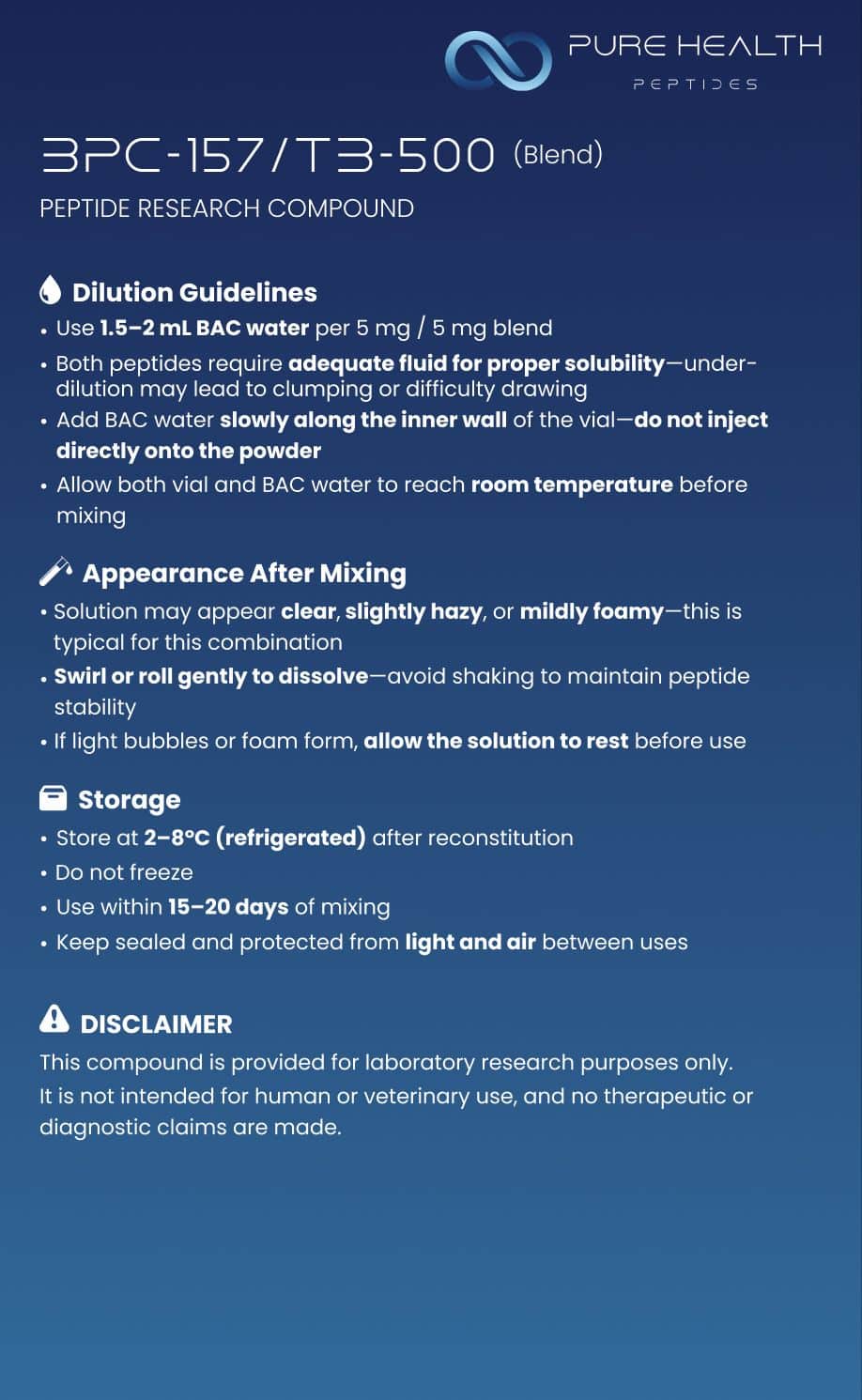
- Lyophilized (freeze-dried) powder: typically reconstituted with a sterile bacteriostatic solution or similar guidance provided by the vendor.
- Reconstituted vial (ready-to-use): sometimes sold as a prepared solution with clear storage instructions.
- Different vial sizes: smaller vials for short trials and larger ones for multi-week routines.
Quality standards and signals to look for (these are the “consumer review” filters I use):
- Third-party testing documentation: COA (certificate of analysis) that matches the exact batch you’re buying.
- Clarity of concentration: visible labeling that helps you measure accurately.
- Sterility/handling guidance: instructions for reconstitution, storage temperature, and discarding dates.
- Batch traceability: lot numbers and consistent sourcing, not vague “proprietary process” claims.
- Responsible marketing: if a seller claims guaranteed healing or “instant results,” that’s usually a red flag.
In many consumer setups, the daily stack approach relies on consistent dosing and careful administration, which is also why product quality signals matter. If you’re paying for peptides, you’re paying for both the chemistry and the reliability around it.
Comparison of Common Options
Prices vary by vendor and country, but the “option type” affects cost structure. Below is a comparison framework based on how people typically choose formats and routines for BPC-157 + TB-500 daily questions.
| Format | Typical Dose/Use | Pros | Cons | Cost | Best For |
|---|---|---|---|---|---|
| Powder vials (reconstitute) | Daily-ish trial; measure and reconstitute per vendor guidance | Often more flexible; easier to size a short experiment | Requires careful handling/sterility; measurement mistakes are possible | Varies; often moderate per vial | People who can follow instructions and track precisely |
| Smaller vials for 1–2 week tests | Daily schedule for a short “experiment window” | Lower commitment; easier to stop early if side effects occur | Cost per mg may be higher | Higher per mg, lower overall risk | Cautious first-timers asking “can you take BPC-157 and TB 500 daily?” |
| Pre-reconstituted solutions | Daily routine with less preparation | Less handling reduces some user error | Storage window matters; “ready” doesn’t mean better quality | Often higher per vial | People who want simplicity and careful storage capability |
| Single-compound purchase | Not both daily—test one first, then consider stacking | Easier to identify what you’re responding to | Slower to answer stacking question | Mixed; can lower initial spend | People who want to isolate variables before any daily stack |
| Stack bundles (BPC-157 + TB 500) | Daily schedule using both compounds in the bundle plan | Convenient; designed to support combined experimentation | If product quality is uncertain, stacking increases complexity and risk | Often bundle discounts; overall depends on mg amounts | People who already trust quality signals and want a structured daily trial |
Buying Framework and Red Flags
If you’re considering BPC-157 and TB 500 daily use, think of purchasing like you’d think about buying lab supplies: verify documentation, confirm labeling, and avoid “trust me” marketing. This checklist is designed for quick filtering.
- COA for the exact batch (not generic screenshots).
- Clear concentration info so you can measure accurately.
- Storage and reconstitution instructions that are specific and consistent.
- No guaranteed results language like “will heal” or “cure in X days.”
- Transparent contact/support so you can ask handling questions and get direct answers.
- Packaging that protects sterility (sealed vials, appropriate labeling).
- Reasonable pricing relative to documentation; extreme bargains can correlate with missing QA.
- Batch/lot traceability you can reference for claims and testing.
One more consumer note: if you ever see inconsistent solution appearance, uncertainty about storage time, or vague “how to use” guidance that contradicts basic sterile handling principles, stop and don’t “push through” because you already paid.

Common Mistakes and How to Avoid Them
- Starting too aggressively for a daily plan: If you can’t identify early side effects, you can’t learn. Consider short trials rather than long commitments.
- Skipping a symptom baseline: “I feel better” is hard to interpret. Track warm-up pain, range of motion, and next-day soreness.
- Changing too many variables at once: Don’t overhaul training volume, sleep, and diet in the same week you start a daily BPC-157 and TB-500 routine.
- Ignoring the possibility of a negative response: If discomfort increases or you feel unwell, stop the plan. A bad experience is still data.
- Assuming oral is equal to injection: Delivery method changes absorption patterns and expectations. Oral vs injection isn’t interchangeable.
- Buying without quality signals: Daily frequency increases how often you’re exposed to whatever risk is in the product or process.
FAQ
Is it proven that BPC-157 and TB 500 daily works for tendon or joint issues?
Human evidence is limited, and much of what circulates online comes from preclinical research and individual reports. A daily stack may be something some people experiment with, but it isn’t “proven” in the way an approved medication would be.
How long does it take if you take BPC-157 and TB 500 daily?
In consumer-style experiences, changes (if they happen) are often discussed in the 1–2 week window. That said, absence of noticeable improvement in that time doesn’t automatically mean it won’t help, and presence of improvement doesn’t confirm causation.
What side effects might happen when taking BPC-157 and TB 500 daily?
Reported issues in user discussions include headaches, stomach discomfort, skin irritation at the injection site, or general fatigue. If symptoms worsen or new problems appear, stop the routine and reassess.
Can you combine BPC-157 and TB 500 daily with other supplements or training compounds?
People combine them with many things, but combinations can complicate cause-and-effect. If you’re stacking other supplements, start one change at a time so you can tell what’s actually driving results or side effects.
Is oral BPC-157 and TB 500 daily equivalent to injection, or are they different?
Delivery method matters. Oral vs injection can differ in absorption and expected effect patterns, so “equivalent dosing” isn’t something you should assume. If you’re choosing between oral and injection/alternative approaches, treat them as different strategies with different expectations.
A Practical 2-Week Experiment Framework
If your goal is to answer “can you take BPC-157 and TB 500 daily?” for your own body, here’s a structured 14-day consumer approach that prioritizes learning and stop rules. It’s designed for people who want a clear outcome without turning it into an endless routine.
- Days 1–2: Baseline—choose 2–3 movements that trigger your discomfort (for example: pressing warm-up, incline variation, or a specific knee angle). Record pain (0–10), range of motion, and next-day soreness. Keep everything else stable.
- Days 3–7: Start a cautious daily schedule—use the vendor’s dosing instructions if you have a product with clear labeling. Track any changes after each dose day and keep notes on sleep, appetite, and workout tolerance.
- Days 8–11: Evaluate—if pain is clearly worse, stop. If there’s no change but no negative reaction, continue briefly to reach day 14 for a fair consumer test.
- Days 12–14: Final check—re-test the same movements you logged on day 1–2. If you improved, you can consider whether to stop after a short trial (many people prefer that). If nothing changed, don’t keep escalating frequency automatically.
- Stop rules—discontinue if you notice concerning side effects, escalating discomfort, or any sterility/handling doubts (like suspect appearance or storage uncertainty).
About cost: if you’re paying roughly $100–$250 for a short batch (varies widely by concentration and region), you can set a practical expectation—this is an experiment window, not a multi-month “fix.” A daily plan makes sense only if you treat the cost as paying for information.
About the Author
Samira Holt is a consumer-focused product reviewer who specializes in evidence-aware fitness and recovery supplement writeups for young adult athletes. Over the last several years, Samira has reviewed recovery routines, training-load management approaches, and peptide-related products using a consistent format: ingredient transparency checks, quality signal evaluation (like documentation and labeling), and structured “what changed” symptom tracking. Samira’s approach emphasizes cautious experimentation and avoids outcome guarantees. This article is for informational purposes only and describes common consumer experiences and buying considerations—it's not medical advice, and it doesn’t promise results.
Discussion